

Why Should Project Professionals Consider an MSP e-Learning Course?

Project professionals often begin their careers by managing individual projects, but progressing into senior roles requires a wider understanding of programme management. Overseeing multiple connected projects means coordinating teams, managing risks, engaging stakeholders, and keeping work aligned with broader organisational objectives. An MSP e-learning Course provides a structured way to develop these skills while allowing professionals to learn at their own pace alongside existing responsibilities. Whether you are an experienced project manager or preparing to take on programme-level duties, MSP training can help you understand how individual projects work together to deliver long-term business benefits.
Why Is MSP Knowledge Important for Modern Project Professionals?
Large organisations often manage several connected projects that share resources, dependencies, and strategic goals. Programme management helps professionals coordinate these projects while keeping attention on wider organisational outcomes. MSP (Managing Successful Programmes) provides a structured approach to governance, benefits, risk, stakeholder engagement, and programme delivery.
Programme Management vs Project Management
Project management usually focuses on delivering specific outputs within agreed time, cost, quality, and scope. Programme management takes a broader view by coordinating related projects and ensuring they contribute to shared outcomes. For example, a business transformation programme may involve technology implementation, employee training, process improvements, and customer communication. An MSP e-learning Course can help professionals understand these broader responsibilities and develop a programme-level perspective.
Building Programme-Level Skills
Programme-level work requires professionals to understand how different projects affect one another. A delay in one project may impact resources, schedules, or benefits across the programme. MSP introduces practical concepts for managing dependencies, risks, issues, stakeholders, governance, and benefits. Professionals can develop these skills through a PRINCE2 Programme Management e-learning Course or PRINCE2 Programme Management e-learning Training, supporting their ability to work effectively across complex, interconnected initiatives in different industries.
How Can an MSP e-Learning Course Improve Programme Management Skills?
Online learning can provide a practical option for professionals who cannot regularly attend classroom sessions. Learners can study according to their schedules while continuing their normal work responsibilities. A structured PRINCE2 Programme Management e-learning Course can cover programme principles, governance, benefits management, stakeholder communication, risk, issues, quality, and tailoring. Learning these areas together can give professionals a clearer understanding of how programme management works. The flexible format can also allow learners to revisit difficult topics, complete exercises, and prepare gradually for relevant assessments.
Understanding Programme Governance
Governance becomes increasingly important as programmes involve multiple projects, teams, decision-makers, and stakeholders. Clear responsibilities help organisations determine who makes decisions, who provides assurance, and how programme progress should be controlled. MSP introduces governance concepts that help professionals understand these responsibilities at programme level. For project managers moving into broader roles, this can provide useful context for dealing with senior stakeholders and programme-level decisions. Understanding governance can also help professionals recognise when an issue needs escalation rather than being handled only within an individual project.
Benefits Realisation
Delivering a project successfully does not always mean that an organisation has achieved its intended benefits. A new system might be delivered on schedule, for example, but the expected improvements may not appear until employees adopt it effectively. Programme management therefore considers benefits throughout the programme. MSP places significant attention on identifying, planning, measuring, and realising benefits. Professionals learning this approach can develop a better understanding of how project outputs contribute to broader organisational outcomes rather than treating successful delivery as the only measure of progress.
Risk and Issue Management
Risks within a programme can affect several connected projects at the same time. A supplier problem, resource shortage, regulatory change, or technical dependency could create consequences beyond one project team. MSP provides a programme-level perspective for understanding and managing these situations. An MSP e-learning Course can help learners understand how risks and issues interact with programme objectives, benefits, resources, and stakeholders. This broader perspective can complement existing project management knowledge and help professionals consider the potential consequences of decisions across multiple related initiatives.
What Career Benefits Can Professionals Gain From MSP Training?
MSP training can help professionals expand their skills beyond individual project delivery and prepare for broader programme responsibilities. It covers areas such as governance, benefits management, stakeholder engagement, risk, and coordinating multiple projects. However, training works best alongside practical experience, communication, leadership, and industry knowledge.
Progression Into Programme Management Roles
Moving from project to programme management requires understanding how multiple projects contribute to wider organisational goals. MSP provides a structured framework for developing this perspective. Foundation study introduces key principles, terminology, and processes, while Practitioner training focuses on applying the framework in practical situations. Professionals considering PRINCE2 Programme Management e-learning Training can use this learning to build programme-level knowledge alongside their existing experience.
Certification and Professional Development
A recognised certification can demonstrate knowledge of a structured programme management framework. MSP Foundation and Practitioner certifications help professionals understand and apply concepts related to governance, benefits, risks, stakeholders, and programme delivery.
Combining MSP With Existing Project Management Skills
MSP can complement existing project management skills rather than replace them. Project management focuses on areas such as scope, budgets, resources, and delivery, while programme management adds strategic alignment, dependencies, governance, and benefits. Professionals considering a PRINCE2 Programme Management e-learning Course or MSP e-learning Course can therefore use it to broaden their existing skill set.
How Should Professionals Choose the Right MSP e-Learning Course?
Choosing the right online programme management course involves more than comparing price and duration. Professionals should check the syllabus, certification pathway, learning resources, examination details, and available support. The course should also cover the current MSP edition and match the learner’s schedule and preferred learning style.
Essential Course Syllabus Areas
A suitable course should explain key programme management areas, including principles, governance, benefits realisation, stakeholder engagement, risk, quality, communication, and tailoring. When comparing an MSP e-learning Course, professionals should review the learning outcomes and ensure they match their career objectives.
Understanding Certification Requirements
Learners should understand the latest examination requirements before enrolling. This helps them choose suitable preparation materials and plan their study time effectively. Certification details can change, so checking the current official requirements is important.
PRINCE2 Programme Management Branding
Professionals may encounter PRINCE2 Programme Management e-learning Course when searching for programme management training. Before enrolling, check the exact certification, edition, examination inclusion, and learning materials provided.
Practical Learning Resources
Practice questions, quizzes, scenario-based exercises, case studies, and progress tracking can make e-learning more effective. For busy professionals, flexible online learning also makes it easier to study around existing work commitments.
Conclusion:
An MSP e-learning route can help project professionals develop a broader understanding of programme management and move beyond individual project delivery. The framework introduces important areas such as governance, benefits realisation, stakeholder engagement, risk, quality, and programme-level coordination. E-learning also provides flexibility for professionals balancing training with existing responsibilities. As Tecknologia continues its PRINCE2 Programme Management branding, learners should carefully check the certification edition, syllabus, examination requirements, and course resources before enrolling. A suitable programme management course can provide structured knowledge that complements practical experience and supports continued professional development across different programme and project environments.
Jobs for People Over 50 in Postal, Logistics, and Federal Roles
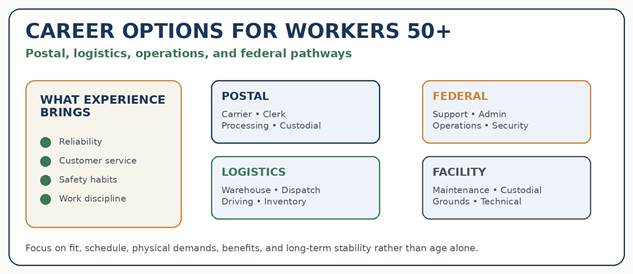
Why Workers Over 50 Still Have Strong Options
Many workers over 50 bring exactly what operational employers value: reliability, attendance, customer service, safety awareness, patience, and experience working under pressure. Postal, logistics, facility, transportation, and federal-support roles often reward consistency and practical work habits more than formal credentials alone.
The best role depends on physical ability, schedule needs, driving history, benefits, commute, and long-term goals. Some jobs are active and demanding, while others focus more on customer service, administration, maintenance, dispatch, or operations support.
Postal Jobs Can Be a Strong Second-Career Option
Postal work appeals to many experienced workers because it offers a large national network, defined job categories, structured pay systems, and career benefits for eligible employees. Openings may include carriers, clerks, mail handlers, custodians, maintenance workers, drivers, and processing employees.
Applicants looking for a broad range of USPS Jobs should compare career and noncareer appointments carefully. Career status often changes the benefit package, retirement participation, leave earning, and long-term job structure.
Which Postal Roles May Fit Workers Over 50?
|
Role Type |
Why It May Fit |
What to Consider |
|
Window or retail clerk |
Customer service, transactions, organized indoor work |
Standing, schedule flexibility, public interaction |
|
Mail processing clerk |
Routine systems, sorting, scanning, teamwork |
Shift work, standing, repetitive motion |
|
Custodial or maintenance |
Practical skills, facility work, clear tasks |
Physical activity, tools, local requirements |
|
Carrier roles |
Independent work, route discipline, outdoor activity |
Walking, lifting, weather, driving |
|
Mail handler |
Warehouse-style operations and teamwork |
Lifting, movement, night or weekend shifts |
Logistics Roles Often Value Experience Over Age
Warehouses, distribution centers, fleet operations, dispatch teams, and inventory departments need dependable employees who understand schedules, safety, deadlines, and accountability. Workers with backgrounds in retail, manufacturing, driving, customer service, office administration, or supervision often have transferable skills.
- Warehouse associate or material handler
- Inventory or stock-control clerk
- Dispatch or route coordinator
- Delivery driver or yard support
- Shipping and receiving clerk
- Facilities or maintenance support
- Customer service for transportation or logistics companies
Federal and Government-Related Roles Beyond Postal Work
Federal and public-sector employers also hire for administrative, operations, security-support, facilities, maintenance, customer-service, technical, and program-support roles. Some positions require specialized credentials, while others focus on experience, reliability, and the ability to follow procedures.
Applicants should review age-related requirements carefully because certain law-enforcement or public-safety occupations have maximum entry ages. Many civilian, administrative, support, facility, and operational roles do not use those same limits.
Physical Demands Matter More Than Age Alone
A job title can sound suitable but still involve heavy lifting, long periods of standing, frequent walking, stairs, outdoor weather, or irregular shifts. Read the physical requirements section before app and compare it with your current capability rather than re on assumptions.
For some applicants, an indoor clerk, dispatch, customer-service, or administrative role may offer a better long-term fit than a high-mileage delivery route or heavy warehouse position.
Location Matters
Availability varies sharply by city. A smaller market may have only a few openings, while a regional hub may have multiple delivery, processing, and support jobs at the same time. Expanding your search radius can improve your options if the commute remains practical.
You can review current Postal Jobs in Alexandria, Louisiana, and compare local openings with nearby markets before deciding which roles best match your schedule and experience.
Benefits and Stability to Compare
Workers over 50 often place more weight on health coverage, retirement, leave, predictable income, and job continuity. Those factors can be as important as the starting hourly rate.
- Health insurance eligibility and employee premiums
- Retirement participation and employer contributions
- Paid annual and sick leave
- Schedule stability and overtime expectations
- Job duration: temporary, noncareer, or career
- Opportunity to move into less physically demanding roles later
How to Position Your Experience in an Application
Do not downplay long work history. Translate it into current employer needs. Focus on attendance, safety, customer service, cash handling, route discipline, supervision, equipment use, documentation, inventory control, and problem solving.
- Use recent examples instead of listing every job from decades ago.
- Highlight reliability and low-error work.
- Show comfort with scanners, mobile apps, email, or basic workplace software.
- Explain transferable skills from retail, manufacturing, driving, hospitality, or office work.
- Keep the resume concise and tailored to the position.
External Career Reference
AARP's career resources provide practical guidance for experienced workers on job searching after 50, including resume updates, interview preparation, and age-bias considerations. Use the specific employer posting for final job requirements.
Frequently Asked Questions
Is 50 too old to start a USPS career?
No. Many postal roles do not have a general maximum hiring age. Applicants must meet the requirements listed for the specific job.
Which postal jobs are less physically demanding?
Retail clerk, some processing, administrative, and support roles may involve less walking than delivery jobs, but standing and shift work may still be required.
Do federal jobs have age limits?
Some law-enforcement and public-safety positions do. Many civilian, support, administrative, and facility roles do not use the same age limits.
Are part-time roles a good way to re-enter the workforce?
Yes. Part-time or noncareer positions can provide current experience and income, but applicants should compare benefits and long-term stability.
Should older applicants mention age on a resume?
No. A resume normally focuses on relevant experience, skills, and achievements rather than age or date of birth.
What matters most when choosing a role after 50?
Physical fit, schedule, benefits, commute, job duration, and long-term stability are often more important than title alone.
Final Takeaway
Workers over 50 have viable options across postal, logistics, facilities, transportation, and federal-support work. The strongest choice is the role that matches your experience, physical capacity, schedule needs, and benefit priorities. Focus on transferable skills and compare the full employment package before app.
Best SMM Panel for Improving Social Media Visibility

Social media visibility plays an important role in helping businesses, creators, influencers, and digital marketers reach a larger audience. With millions of posts published every day, simply creating quality content may not always be enough to attract attention. A reliable SMM panel can help marketers manage promotional activities more efficiently while supporting their broader social media strategies. The Best SMM Panel for improving social media visibility should offer useful services, transparent pricing, dependable performance, and easy management. Choosing the right platform can make social media promotion more organized and allow users to focus more time on content creation, audience engagement, and brand development.
Understanding Social Media Visibility
Social media visibility refers to how easily people can discover and interact with a brand, profile, page, or content across social platforms. Higher visibility can increase opportunities for engagement, website visits, brand awareness, and audience growth.
Several factors can influence visibility, including content quality, posting consistency, audience interaction, platform algorithms, hashtags, trends, and promotional strategies. An SMM panel can become one part of this process by providing tools or services designed to support social media promotion.
However, an SMM panel should complement organic marketing rather than replace it. Valuable content and genuine audience relationships remain essential for long-term social media success.
What Is an SMM Panel?
An SMM Best smm panel , or Social Media Marketing panel, is an online platform that allows users to purchase or manage various social media marketing services from one dashboard. Depending on the provider, available services may cover platforms such as Instagram, Facebook, YouTube, TikTok, X, and others.
Services can vary considerably between providers. Some panels focus on engagement-related services, while others provide broader marketing solutions. Before choosing a platform, users should carefully examine what each service actually provides and whether it fits their marketing objectives.
A good panel should make campaign management simple and provide clear information about pricing, service details, delivery, and support.
Features to Look for in the Best SMM Panel
Not every SMM panel provides the same level of quality or reliability. Several features deserve attention when comparing different options.
Easy-to-Use Dashboard
A straightforward dashboard makes it easier to create orders, monitor campaigns, review balances, and manage multiple activities. An organized interface can save time, particularly for agencies handling several clients.
Wide Platform Support
Businesses often maintain profiles across several social networks. A panel supporting multiple platforms can make promotional management more convenient and reduce the need to use separate services.
Transparent Pricing
Clear pricing helps marketers plan budgets effectively. Users should understand exactly what they are paying for before placing an order. Hidden fees and unclear service descriptions can make campaign management difficult.
Reliable Customer Support
Responsive customer support is valuable when users experience payment issues, order problems, or questions about services. Providers that offer accessible support channels can make the overall experience smoother.
Performance Tracking
Analytics and order tracking help users understand how campaigns are progressing. Monitoring results can also help marketers determine which strategies deserve more attention.
How an SMM Panel Can Support Visibility
An SMM panel can simplify repetitive promotional tasks and provide convenient access to marketing services. For example, a marketer managing several social media profiles may use a centralized dashboard to organize campaigns instead of handling every activity separately.
Improved visibility can also make content easier for potential audiences to discover. When promotional activities are combined with strong content, consistent posting, and meaningful engagement, businesses can create a more complete social media strategy.
The most effective approach is to use promotional tools carefully while continuing to build authentic relationships with followers.
Choosing the Right SMM Panel
Selecting an SMM panel should begin with identifying specific marketing goals. A small business may prioritize affordability and simplicity, while an agency may need advanced management capabilities and support for multiple clients.
Consider factors such as:
- Supported social media platforms
- Available services
- Pricing structure
- Dashboard usability
- Customer support
- Order processing information
- Reporting and tracking features
- Provider reputation and transparency
Reading independent reviews and checking service details can also help users avoid unreliable providers.
Combining SMM Services With Organic Growth
An SMM panel should not be treated as a complete social media strategy. Organic content remains important for building credibility and maintaining audience interest.
Businesses should continue publishing useful posts, responding to comments, understanding their target audience, and experimenting with different content formats. Video content, educational posts, customer stories, behind-the-scenes material, and interactive content can all contribute to stronger audience relationships.
Paid or panel-based promotional activities can then be incorporated as one supporting element within the broader strategy.
Measuring Social Media Results
Visibility should be measured using meaningful performance indicators rather than focusing on a single number. Depending on the platform and campaign goals, marketers may monitor impressions, reach, profile visits, engagement, website traffic, conversions, and audience growth.
Regularly reviewing these metrics makes it easier to identify successful approaches and adjust underperforming campaigns. This data-driven process can help businesses use their marketing budget more efficiently.
Conclusion
Finding the Best SMM Panel for improving social media visibility requires careful comparison of services, pricing, reliability, support, and management features. A quality panel can simplify promotional activities and help marketers organize campaigns across multiple social platforms. Nevertheless, sustainable visibility depends on more than promotional services. High-quality content, consistent activity, authentic engagement, and regular performance analysis are equally important. By combining an appropriate SMM panel with a well-planned organic social media strategy, businesses and creators can build a stronger and more consistent online presence.
Australian Peptides: What Researchers and Buyers Should Know

Australian peptides have gained attention as peptide science continues to develop across research, biotechnology, and pharmaceutical fields. However, understanding peptide products requires more than looking at a product name or geographic association. Researchers and buyers need to consider quality, identity, documentation, storage, intended use, and applicable regulations before making decisions.
Understanding the Peptide Product
The first step is identifying exactly what a peptide product contains. A peptide is generally a chain of amino acids, but different sequences can have very different molecular properties. Small changes in structure may influence stability, solubility, and biological interactions.
When examining Australian peptides, buyers should therefore look for clear information about the peptide's name, sequence where appropriate, quantity, formulation, and intended purpose. Transparent product information can make it easier to determine whether a material fits a particular research requirement.
Purity Matters
Peptide purity is particularly important for laboratory work. Impurities can interfere with experiments and make results more difficult to interpret. Depending on the application, researchers may review analytical information showing the composition and quality of the supplied material.
Common analytical approaches include chromatography and mass spectrometry. These techniques can help verify peptide identity and provide information about purity. Buyers should pay attention to available certificates of analysis and other supporting documentation rather than re solely on marketing claims.
Research Use and Intended Applications
One of the most important distinctions is whether a peptide is intended for research purposes or an approved medical application. Research peptides may be used by qualified laboratories to investigate biological mechanisms, molecular interactions, or potential future applications.
Experimental research should not be confused with established medical treatment. Results from laboratory studies or early-stage investigations do not automatically establish that a peptide is safe or effective for people.
Supplier Transparency
Supplier information is another consideration when exploring Australian BPC-157/TB-500 Blend 10mg . A transparent supplier should provide meaningful details about product specifications, testing, storage, and handling.
Researchers may also consider whether documentation is consistent across products and whether important information is easy to obtain. Clear communication can help laboratories assess materials before incorporating them into their research processes.
Storage and Handling
Peptide stability varies between compounds. Some materials may be sensitive to temperature, moisture, light, or repeated exposure to unsuitable conditions. Improper handling can potentially affect material quality.
Buyers should carefully follow the storage and handling instructions provided for the specific product. Maintaining appropriate conditions from delivery through laboratory use is an important part of preserving research materials.
Understanding Testing Documentation
Certificates of analysis can be valuable when evaluating peptide materials. Depending on the supplier and product, documentation may contain information about identity, purity, batch number, quantity, and analytical testing.
Researchers should review these details rather than assuming that every peptide product has identical characteristics. Batch-specific information can be particularly useful because manufacturing results can vary between production runs.
Regulatory Considerations
Regulatory requirements are an important part of peptide purchasing. Requirements can differ depending on whether a material is being supplied for laboratory research, pharmaceutical development, or another purpose.
Buyers should understand the rules that apply in their location and ensure that products are used only in accordance with applicable requirements. Claims about human use should receive particular scrutiny because research status and regulatory approval are separate matters.
Avoiding Unsupported Claims
The growing interest in peptides has also produced a large amount of online information. Some sources may make broad claims that are not supported by strong scientific evidence. Researchers and buyers should distinguish between peer-reviewed research, supplier information, anecdotal experiences, and promotional content.
Looking for primary research, recognized scientific publications, and appropriate technical documentation can provide a more reliable foundation for understanding a peptide.
Making an Informed Purchase
Before purchasing Australian peptides for legitimate research, buyers can consider several practical questions:
- Is the peptide clearly identified?
- Is the intended research use stated?
- Is analytical or batch documentation available?
- Are purity and quantity specifications provided?
- Are storage and handling requirements explained?
- Does the supplier provide transparent contact and product information?
- Are applicable regulations understood?
These questions can help buyers assess materials more systematically.
Conclusion
Australian peptides are part of a rapidly developing scientific field, but responsible evaluation requires careful attention to evidence and product quality. Researchers and buyers should consider peptide identity, purity, testing documentation, storage requirements, supplier transparency, and regulatory status before making decisions. A careful approach helps distinguish scientifically documented information from unsupported claims and provides a stronger foundation for responsible peptide research.
How to Choose a Reliable Service for Car Shipping From UK
Choosing the right transportation provider is an important part of arranging international vehicle delivery. When a vehicle is being shipped across borders, owners want clear communication, appropriate handling, transparent costs, and dependable logistics. However, comparing providers can sometimes be challenging because different companies offer different services, routes, prices, and shipping methods. Taking time to evaluate your options can help you find a service that matches your vehicle, destination, budget, and schedule. Here are several factors to consider when choosing a service for car shipping from UK.
Research the Company
Begin by researching potential vehicle shipping companies. Look at how long they have been operating, what destinations they serve, and what types of vehicles they transport.
A professional company should be able to explain its shipping process clearly. Check whether the provider specializes in international vehicle transportation and whether it regularly handles shipments to your intended destination.
Check Available Shipping Methods
Different vehicles and destinations may require different transportation methods. Common options can include container shipping and roll-on/roll-off transportation, depending on the route and provider.
Ask each company which method is available for your destination and what it includes. Understanding the differences can help you compare services based on practical requirements rather than focusing only on the headline price.
Ask for a Detailed Quote
Price is an important consideration, but the cheapest quote is not automatically the most suitable option. Request a detailed quotation that explains what is included in the total cost.
Ask whether the price covers collection, port handling, documentation, customs-related services, insurance, and final delivery. A clear quote can make it easier to identify additional charges before committing to a service.
Review Insurance Coverage
Vehicle transportation involves potential risks, so it is important to understand the insurance arrangements before shipping. Ask the provider what type of coverage applies during transportation and what exclusions or limitations may exist.
Request written information about the coverage and find out how the claims process works. Understanding these details in advance can prevent confusion if an issue occurs.
Evaluate Customer Communication
Good communication is particularly important when shipping a vehicle internationally. The company should be able to answer questions about collection, documentation, shipping schedules, and delivery procedures.
Pay attention to whether representatives provide clear and consistent information. A provider that explains the process thoroughly can make it easier for customers to understand what happens at each stage of car shipping from UK.
Read Customer Reviews Carefully
Customer reviews can provide useful information about other people’s experiences. Look for recurring comments about communication, vehicle handling, punctuality, documentation, and customer support.
However, avoid re on a single review. Consider multiple sources and look for consistent patterns. Reviews should be one part of your research rather than the only factor used to select a provider.
Confirm Documentation Requirements
International vehicle shipping involves documentation, and requirements can vary according to the destination. Ask the shipping provider for a complete list of documents you will need.
This may include vehicle ownership documents, identification, registration information, invoices, and customs paperwork. Confirm deadlines as well as submission methods so that missing documents do not interfere with your shipment.
Ask About Tracking and Updates
Some shipping providers offer shipment updates or tracking services. Ask how you will receive information about your vehicle once it has been collected.
Regular updates can make it easier to understand where your vehicle is within the transportation process. If live tracking is unavailable, ask how frequently the company provides status updates.
Consider Collection and Delivery Options
Check whether the provider offers door-to-door service, port-to-port transportation, or other collection and delivery arrangements. Your choice may depend on your location, destination, budget, and vehicle requirements.
Ask whether collection and delivery fees are included in the quoted price. Confirm the addresses and any restrictions that could affect vehicle pickup or delivery.
Review the Terms Before Booking
Before signing an agreement, carefully review the terms and conditions. Pay attention to cancellation policies, payment schedules, insurance provisions, estimated transit times, and procedures for handling delays or vehicle damage.
Do not hesitate to ask questions about anything that is unclear. A reliable shipping provider should be willing to explain its terms before you make a commitment.
Conclusion
Selecting a suitable provider for car shipping from UK requires careful comparison rather than focusing on price alone. Research the company, compare shipping methods, request transparent quotes, check insurance coverage, review customer feedback, and confirm documentation requirements. Clear communication and well-defined terms are also important when arranging international vehicle transportation. By evaluating these factors before booking, vehicle owners can make a more informed choice and prepare for a smoother cheap car shipping from UK experience.